Many birders of a more "traditional" nature tend to scoff upon the idea of a "Big Day", a 24-hour calendar day period in which one sets out to find as many species as birds as possible in a specified area, usually a county or state. Their argument normally centers around the amount of resources consumed on a Big Day, namely gasoline, and many dismiss it as a silly, pointless pursuit...a game. Yes indeed, it is a game, a way to help rid birding of it's widespread passive stereotype. In my view, the way each birder thinks of the act of birding can fit into one of three categories- an art, a science, or a sport, or any combination of the three. Big Days are a way to bring a competive aspect to the activity of birding, whether the competition is against yourself or against others who have previously set Big Day records. It is a change of pace from the mundane, from the covering of the same small, general area day after day. It is a motivator to get out there, bird and learn. Lastly, a Big Day is not pointless at all. It is a tremendous learning tool, in many ways moreso than the more thorough or casual forms of birding. For me, my first official Big Day was in February of this year. I had done many informal "Big Days" on my own before, but those were mainly a competition against myself to see whether I could find 75...90..100 species in a given area in a day. Official Big Days comply by American Birding Association (ABA) rules, and are submitted to them once a year for inclusion in their record books. I have now done 5 official Big Days this year, four in North Carolina and one in Washington. I have learned a tremendous amount from each and every one of them.
In order to successfully plan a Big Day route, one must have an in-depth knowledge of exactly where to find each expected species. Ok, no big deal right? Wrong. Think about it for a minute. When running a Big Day, the phrase "plenty of time" are alien words. This means that you are forced to find as many species as possible in as few and quick of stops as possible. Okay, so just hit the major hotspots along your planned route and you'll get a good enough tally. Wrong again. In a Big Day, no tally is "good enough". Even if it is close to dusk and you have already broken the previous monthly/state record, you don't stop. You try for owls and rails after dusk, giving your absolute 100% until you just absolutely can't bird any more. Caffiene is essential. And if you only bird at hotspots along the Big Day route, a surprising number of common birds will be missed, even if most of the more uncommon species are found. Thus, it is essential to integrate short stops for specific target birds in with several hotspots during the day. This is where an inherent knowledge of bird distribution and abundance comes in. You have to have locations planned where you can find Blue Jay, Tree Swallow, White-breasted Nuthatch, and other common species, as well as backup locations for each one. House Sparrow can be surprisingly tricky to find along some Big Day routes in NC. Many times, the common birds dissappear when you really need to find them on a Big Day. This is why you need backup, even multiple backup locations for as many of these as possible. From doing four Big Days in NC this year, I have learned a surprising amount about reliable locations for common and uncommnon species that I never thought about before. Sometimes you need to make spur-of-the-moment stops to pick up species that you missed elsewhere, and this is where deep knowledge of habitat preferences comes in. This patch of habitat is too small, too wet, too dry, too youg, etc. for species X, lets not waste time here and instead travel on down the road to find some better looking habitat. Ali Iyoob and I did a Big Day earlier this month, ending with 130 species, which was a new NC November record (more on that Big Day in a following post). Some of our big misses that day were- American Goldfinch, House Sparrow, Brown Thrasher, Hermit Thrush, and Sora, all common birds in November in the right habitat in eastern NC.
Big Days also require a keen ear, since most species of landbirds are checked off for the day's tally by sound alone- whether it be a Kentucky Warbler's song, a Downy Woodpecker's whinny, the crisp call note of a Swamp Sparrow, of the flight call of a Bobolink. To end with a respectable total for the day, it is absolutely essential to know at least all the usual vocalizations of the expected landbirds on your route. This serves as a motivating tool to study up on vocalizations before hand, especially if you are not one to bird by ear often. Also, upon hearing an unknown vocalization on a Big Day, the potential addition of a species to the day's tally drives you to track down the bird as quickly as possible. For me, this has proven to be the most effective way to learn a new "chip" note. Many birders are resistent to birding by ear though, whether the reason is failing hearing, an overwhelming sensation of "I can never learn all these songs!", or something else entirely. I have birded primarily by ear for years, and can attest to it's effectiveness. Upon looking back on past daily checklists, especially from forested settings, I would estimate that in certain circumstances, 75% or more of these species were ID'd by ear first, many of which I never ended up actually laying eyes upon. Thus, you can see why birding by ear is essential to the success of a Big Day.
Conducting a Big Day also causes you to he hyper-vigilant. In normal circumstances, such as casually birding with a friend or while on a field trip, birders tend to get lost in conversation instead of actually birding. I have observed this phenomenon especially while driving between birding spots. Yes, I am guilty of this myself (many times over) and have probably missed many noteworthy birds this way. On a Big Day though, there is no room for error here...every bird counts. Thus, you are just as alert while driving, looking for distant raptors soaring or for a different looking sparrow flushing out of that roadside ditch, as you are while actually birding. A good example- back to when Ali and I did a Big Day earlier this month. Super alert while driving, always scanning the marsh edges, the distant horizons, and the telephone wires, we spotted a Glossy Ibis in the marsh by the north end of the Oregon Inlet bridge along route 12. Glossy Ibises are very hard to find on the Outer Banks that late in the season, and was an exceptional bonus bird for us on the Big Day. If we weren't extra-alert and constantly lokoing, then we most likely would have missed the bird entirely.
A unique aspect of a Big Day is that every bird is equally important. Okay, you say, all birds are always important, not just on a Big Day. Entirely correct, chickadees are just as important as condors in all circumstances. But these common birds, chickadees, titmice, cardinals, grackles, doves, tend to get passed over on a daily basis by msot active birders. A North Carolina birder will pay much more attention to a Masked Duck than to a Mallard, at least in NC. The reason is clear- there is only one state record for Masked Duck, but Mallards can be seen virtually anywhere. On a Big Day though, a Masked Duck and a Mallard are treated as equals- each will add one species to your list for the day.
While talking to non-birders, mentioning that you have just done, or are about to do a Big Day is a great way to spark interest immediately. Many are turned off from the idea of birding if they think it is purely a passive hobby for the rich elderly (which is still the widespread stereotype, although The Big Year helped). If introduced to the competitive aspect however, many view it as a sport, a break from the mundane, and even view it as "cool". I have observed this personally on several occasions. On one occasion in particular, I stopped at a gas station in Raleigh, NC about 9PM the day before a Big Day to buy two 5-hour energy shots to keep me going the next day. The cashier was in his late twenties, and made a remark along the lines of "lot of partying tonight"? I said no, early morning tomorrow...getting up at 2AM to drive halfway across the state in order to see as many species of birds as possible. His response was "Dude, thats totally cool". I ended up telling him about it for the next 5 minutes or so, and he was captivated. Similar responses have been evoked from fellow students at WCU to whom I have mentioned my Big Days.
Many Big Day birders have pledged charitible donations for every species recorded on a Big Day, or have gotten sponsors to do so. If you have the means, this is a great way of helping to publicize exactly what it is that you are doing and also serves as a way to offset the impact you have on resources while doing it.
Big Days= extreme birding. They are not for the faint of heart. In summary, Big Days are not just a silly, wasteful game. They are a way to further your avian knowledge, break away from the usual birding stereotypes, perhaps help spark interest in non-birders, and most of all, see a lot of birds and have fun!!!!! So get out there and bird, bird, bird, and go ahead, try a Big Day! You won't regret it.
Wednesday, November 30, 2011


Saturday, November 19, 2011
Worth the drive!
Last night, Dwayne Martin gave me a heads up about a probable adult male Allen's Hummingbird that was coming to a feeder just outside the office of Riverbend Park, in Catawba County, NC. From Cullowhee, this is slightly over a two hour drive, but I didn't hesitate! Allen's Hummingbird would be a life bird for me and if accepted by the NCBRC would constitute only a second NC record. It is widely known that the separation of female and immature Selasphorus hummingbirds in the field is next to impossible, but most birders wouldn't think twice about the identification of an adult male. However, a word of caution- male Rufous Humingbirds in particular can be quite variable in their plumage, and have been known to show extensive green on it's mantle, which is perhaps the most obvious and well-known field mark for differentiating between Rufous and Allen's in the field. Thus, it is hard, if not impossible, to obtain a foolproof identification of a green-backed Selasphorus in the field. The extensive green on the back of the bird in question as well as the appearance of a slightly smaller size made Dwayne suspicious yesterday, and after researching the issue farther, taking a few photos, and contacting Bob Sargeant (one of the leading hummingbird experts in the country), became as certain as he could of the ID of Allen's without having the bird in hand. Now, Dwayne is one of only three people in NC licensed to band hummingbirds, and like the others, bands mainly hummingbirds of winter occurence in NC. So, it went without question that this little guy was going to recieve some jewelry around it's leg. I was privileged to be one of the few people that Dwayne privately tipped off about the bird last night, so made a plan to meet him at 7 this morning to band and photograph it.
Dwayne, along with Lori Owenby, Monroe Pannell, Dave Harden, and several other Hickory-area birders were gathered in the park office upon my arrival. The bird was quick to show, and at 7:37 decided to fly into the cage trap! When banding hummingbirds, the most common approach to trapping them involves placing the feeder into a wire cage trap with 3 doors- a small one on opposite sides, and a large door in the front of the trap. While standing a safe distance away to be sure not to scare the bird, the door is help open by a long string held on the other end by the trapper. When the bird flies into the trap to access the feeder (placed in there earlier), the trapper releases the string and as a result the large, front door shuts- trapping the bird in the cage. The bander then accesses the bird by sticking their arm through one of the small, side doors, and after cornering the bird, is able to safely remove it from the cage and take it for banding and processing.
Dwayne's measurements, mainly of wing and tail length, confirmed that this bird was clearly an Allen's. Curved culmen, extensive rufous rump, very extensive green on the back, and the ovate overall shape of the green back all helped to confirm the ID of Allen's Hummingbird. About 5 minutes after releasing the bird, it was back at the feeder and feeding regularly, just like nothing had ever happened! It was interesting to note that the hummingbird was just small enough that it wasn't able to perch on the established feeder perch and still reach the feeding hole. Instead, it had to precariously perch on the side of the actual feeder itself! A Rufous is large enough that this wouldn't be a problem.


I then set up near the feeder with me camera for about 45 minutes, hoping to either get a shot of the bird either perched or on the feeder. It would be a good complement to the in-hand photos I got earlier. The bird was skittish at first, and abandoned his first quest to the feeder because of my (and my camera+tripod) presence. Shortly thereafter however, it returned to feed for about 20 seconds, allowing a few decent shots. I decided to switch positions so that I could get a better angle on the bird. About 10 minutes later, he returned, allowing some nice shots.

A great bird, and a great time seeing some old friends and acquaintances! A day (or part of a day, technically) well spent.
Dwayne, along with Lori Owenby, Monroe Pannell, Dave Harden, and several other Hickory-area birders were gathered in the park office upon my arrival. The bird was quick to show, and at 7:37 decided to fly into the cage trap! When banding hummingbirds, the most common approach to trapping them involves placing the feeder into a wire cage trap with 3 doors- a small one on opposite sides, and a large door in the front of the trap. While standing a safe distance away to be sure not to scare the bird, the door is help open by a long string held on the other end by the trapper. When the bird flies into the trap to access the feeder (placed in there earlier), the trapper releases the string and as a result the large, front door shuts- trapping the bird in the cage. The bander then accesses the bird by sticking their arm through one of the small, side doors, and after cornering the bird, is able to safely remove it from the cage and take it for banding and processing.
Dwayne's measurements, mainly of wing and tail length, confirmed that this bird was clearly an Allen's. Curved culmen, extensive rufous rump, very extensive green on the back, and the ovate overall shape of the green back all helped to confirm the ID of Allen's Hummingbird. About 5 minutes after releasing the bird, it was back at the feeder and feeding regularly, just like nothing had ever happened! It was interesting to note that the hummingbird was just small enough that it wasn't able to perch on the established feeder perch and still reach the feeding hole. Instead, it had to precariously perch on the side of the actual feeder itself! A Rufous is large enough that this wouldn't be a problem.


I then set up near the feeder with me camera for about 45 minutes, hoping to either get a shot of the bird either perched or on the feeder. It would be a good complement to the in-hand photos I got earlier. The bird was skittish at first, and abandoned his first quest to the feeder because of my (and my camera+tripod) presence. Shortly thereafter however, it returned to feed for about 20 seconds, allowing a few decent shots. I decided to switch positions so that I could get a better angle on the bird. About 10 minutes later, he returned, allowing some nice shots.

A great bird, and a great time seeing some old friends and acquaintances! A day (or part of a day, technically) well spent.
Wednesday, November 16, 2011
Fall in Florida: Part I
Before fall even came around, I was scheming up a birding plan for fall break, which at my school (Western Carolina University) was October 13-18. I was down to two choices- Cape May, NJ or a trip to Florida. I have birded Cape May in mid-October once before, during a young birders camp with the American Birding Association in 2007. The raptor migration was phenomenal, and there were still a good number of passerines coming through as well. Having Michael O'Brien and Louise Zemaitis as leaders for our group certainly helped our bird-finding cause. There is also the matter of the Brown Booby, which would be a lifer for me, who has been settled in near Two Mile Landing in Cape May for the last couple months. But, Florida could give me multiple lifers, especially if I had good luck in the Keys and Everglades. Plus, a rarity of some kind is certainly possible down there in mid-October. I won't go as far as to say "likely", but maybe just one baby step below that classification. So, the decision was made. Brent Mills, a friend of mine from school who had recently gotten hooked on birding, decided to come with. Great! I also made a decision to bypass the established, countable exotics in and around the Miami area. This was almost changed at one point on the trip, but more on that later.
I am not one to get excited about exotics, and although I enjoy list-keeping as much as the next birder, I would much rather concentrate on finding all the native species first. The fact of the matter is, Red-whiskered Bulbuls, White-winged Parakeets, etc. do not belong in south Florida. Ornithologically speaking, there really is no advantage to having these birds around. I could go to PetSmart and see some of these species if I wanted to. Thus, in my opinion, chasing after these birds is something done almost exclusively for listing purposes, to be done on a Big Year or Big Day, for padding an already extensive Florida list, or for something to do if one has a spare day or so. Some may differ with my opinion on this, but I will admit that it is worthwhile to keep tabs on their populations in the area in general. I thought that it was funny that the very first thing multiple birders asked me, upon hearing that I was visiting Florida to bird for a few days, was what my plan was for the exotics. I didn't have one. I was tempted at one point, however, when a big time local birder offered to guide us around Miami to get all the countable exotics. We were an hour away from Miami at the time, and that excursion would have taken up the whole afternoon and taken time away from the Everglades. The weather was looking iffy for the afternoon, but even iffier for the next day, so we decided to head on to the Everglades as originally planned.
We left school after class on the 12th, and arrived in Titusville after a nine (ish) hour drive and caught a few hours of not-so-restful sleep at an interstate rest area. Personally, I like the idea of doing this. First of all, it is free. Secondly, it is *relatively* safe, for most rest areas are well-lit and in Florida are constantly patrolled by 24-hour security. Usually, there are a number of other travelers doing the same thing as well. Sleeping in the car is not the most comfortable thing in the world, but you get used to it after a while. And if you're tired enough, it doesn't really matter anyways. From the point of view of an unemployed college student, the 50-60 bucks a night that I save by doing this add up over the course of a few nights and then, bingo! A few hundred bucks still in pocket, enough for another birding trip!
We started birding on the 13th by listening for nocturnal migrants passing over from the entrance to Black Point Wildlief Drive at Merritt Island NWR. I visited Merritt Island several times during my visit here in January, 2010 and was impressed. Logistically, it was a great place to start off on this trip. We heard Gray-cheeked (1), Swainson's (several), and Wood (1) Thrushes passing over pre-dawn, as well as a couple Bobolinks (right at dawn). Stops by the visitor center and Oak Hammock (I think that's what it is called, I'm going strictly from memory here!) yielded a handful of warblers, vireos, flycatchers, buntings (indigo and painted), and a Summer Tanager. After the gate to Wildlife Drive opened about 8, we took a quick drive through and found Palm Warblers and Common Yellowthroats to be about the two most common birds around. The expected variety of waders was present as well, but nothing really unusual birdwise. The highlight of this stop was a very photogenic Dusky Pygmy Rattlesnake that we found near the restrooms about halfway through the Drive. We had been tipped off earlier to look for them here. It appeared to be an adult, with three rattles. I was amazed at how small it was though, I have seen Carolina Pygmy Rattlesnakes on two occasions previously and this little guy was dwarfed by them! After finishing our loop around Wildlife Drive, we briefly tried for Florida Scrub-Jay on the refuge, but to no avail.
 Snowy Egret- Merritt Island NWR
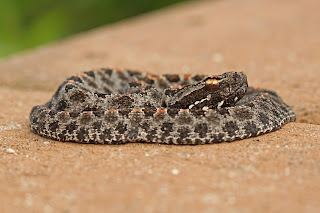 Dusky Pygmy Rattlesnake- Merritt Island NWR
Next up our agenda for the day was to stop by Blue Heron Wetlands while heading south along I-95, which just off the interstate right outside Titusville. It was pretty quiet here, so we went on down to Viera Wetlands, site of the perennially wintering Masked Duck that I saw 3 times in as many days in January 2010. We were dismayed to see upon arrival that the gate was closed to prevent vehicular traffic from driving the dirt road around the "pools". Apparently, the gate is closed periodically after heavy rains due to the conditions of the dirt road. It had been several days since a heavy rain, however, and the roads appeared fine to me. Guess they just hadn't gotten around to opening it again yet. While visiting the porta potty by the parking lot, I heard a quiet clattering on the roof for a few seconds. When I exited, Brent showed me a couple photos he took with my camera--a shrike! The pair of resident Crested Caracaras that like to hang out in the pines around the parking area gave us some nice looks. We didn't have a whole lot of time, so just walked a short distance in along the dirt road around the first pool. Scoping the adjacent ag fields we found a pair of Sandhill Cranes and a Wood Stork. Apart from this, the majority of the birds we saw here consisted of Anhingas, Common Gallinules, Great Egrets, Great Blue Herons, and Tricolored Herons. The fact of the matter is, there's just not much bird activity at midday when it is 95 degrees, even in October! Common Gallinule used to be known as Common Moorhen, up until the latest edition of the AOU's taxonomic revisions. Common Moorhen was then split into two species- the Eurasian species, which retains the name of Common Moorhen, and the American species, which is now to be known as Common Gallinule. I still haven't gotten used to that change yet, and have found my self still calling the American species by it's old name of Common Moorhen more than once!
From Viera, it was south on I-95 to a place known as Wakodahatchee Wetlands. This is one of two adjacent sites (the other is Green Cay Wetlands) described in the Florida Birding Trail: East guide. I was referred here by a photographer whom I met at Jackson Park (Hendersonville, NC) several weeks before. He apparently lives part time at Beech Mountain, NC and part time near Lake Ocechobee, FL so has a lot of experience down there. Wakodahatchee is a small wetland complex containing a quarter mile long boardwalk. It is an oasis of sorts, for it is surrounded on all sides by suburbia- the extreme outer reaches of Miami. A few warblers, Yellow-throateds and Prairies, were in the oaks by the boardwalk entrance. Walking the boardwalk gave us nice views at a number of waders- both ibis, all three white egrets, and a number of herons (including Black-crowned Night-Herons). Anhingas as well as Double-crested Cormorants were everywhere. We once saw a Florida Softshell Turtle, a species which belongs to a group of very odd-looking creatures. I love 'em. At one spot along the boardwalk, a large alligator had his head above the water directly beside and below the boardwalk. We stood on the boardwalk and looked almost directly down, a distance of about 3 or 4 feet, into the eyes of the majestic beast.
One thing that we were surprised to come across at Wakodahatchee was a three and a half foot long orange iguana feeding in the top of a bush on an island in a pond! We were to see more of these in the Keys, but were partially dumbstruck at the time.
 Florida Softshell Turtle- Wakodahatchee Wetlands
 Anhinga- Wakodahatchee Wetlands
 large, orange Iguana- Wakodahatchee Wetlands
With some daylight still left, we decided to head to Brian Piccolo Park in the Miami area to try for Burrowing Owls. This is supposed to be a great place for them, and from what I had read beforehand they should be almost a sure thing here. We were not disappointed. The park is little more than an expansive conglomeration of sports fields and open space, and there were people everywhere upon our arrival. I had read that the owl burrows were roped off to protect them from mowing, so we drove through the park looking for small, staked and roped off areas. When we got to the backside of the park, jackpot! Four burrows in close proximity to one another each contained a pair of Burrowing Owls. This was in and around a large mowed open area surrounded by jogging and dog-walking paths with a couple of children's playgrounds nearby. The light was beginning to fade, so I mounted my camera and flash setup on a tripod and got to work. For the better part of an hour, I was able to get some nice photos and videos of the owls at point blank range. My approach to this was to the select the most photogenic burrow and to concentrate on that pair of owls for the whole time. Occasionally, the two birds would squabble with each other or one catch a grasshopper, but for the most part they stayed in relatively the same positions. The birds were completely unafraid of people, both Brent and I as well as passing joggers or dog walkers. When I had to put my camera up as a result of the impeding darkness, all eight owls in the immediate area began to actively feed. Burrowing Owls are small birds, only slightly bigger than a screech-owl, and their diet consists of mainly large insects. They would pluck grasshoppers and other insects from the grass as well as snatch moths and other flying insects out of mid air. One thing that struck me most profoundly about these birds was their eyes. Huge, and bright yellow. Here are a couple of shots:


A scattering of migrants greeted us the next morning at Bill Baggs Cape Florida Sate Park, our first stop for the day. This is one of the largest passerine migrant hotspots in south Florida, and has served historically as a good rarity attractant as well. We did not see anything unusual here, neither in terms of species of individuals. The next several days, however, would prove to be epic in terms of sheer numbers of passerines in the Miami area and the Florida Keys. Prevailing strong southerly winds, in conjunction with lots of rain, stopped southbound migrants when they hit the end of the road before open water. Migrant traps in the area would turn up incredible numbers of warblers, cuckoos, vireos, etc. over the next few days, as well as rarities like Tropical/Couch's Kingbird, Thick-billed Vireo, and Bananaquit. A few other quick stops in the area netted us a handful of new trip birds, and then it was on to the Keys!
I was greatly excited about the prospect of visiting the Keys. Of course, there are lots of awesome birds to be seen there, but taking a few moments to soak in the whole essence of Key West was sure to be an experience in and of itself. Regretfully, our scheduled itinerary did not allow us much time there at all. If we were going to visit the Everglades and then proceed to bird up the gulf coast while still arriving back at WCU before classes resumed, then we would not have more than an afternoon to spend in the Keys.
A decision we made, ultimately quite beneficial, was to drive straight down US1 through the Keys until Key West, where we would first stop at the Key West Botanical Gardens, which officially closes at 4 every afternoon. This is known as an excellent place to view migrant passerines, and a good spot for rarities to show up on occasion. It is also known to be a reliable place to find White-crowned Pigeons.
That afternoon of the 14th yielded one of the more impressive flights of raptors over the Florida Keys in an already epic season of fall raptor migration. Curry Hammock State Park runs an annual hawk watch, and has recorded absolutely staggering numbers of many species this year. However, Curry Hammock is not the only place to see migrating raptors in the Keys, or for that matter, south Florida in general. We observed an astounding number of raptors flying overhead while simply driving south along US1 in the western half of the keys, including several peregrines, Merlins, and two Swainson's Hawks soaring underneath a kettle of Broad-wings. Swainson's Hawks are a widespread western species that, like the Broad-winged Hawk of the east, stage dramatic migrations every fall to South America. Usually, one would have to be exceedingly lucky to find a Swainson's Hawk in the east, period. But in south Florida, particularly the Keys, small but regular numbers of Swainson's Hawks, maybe 1 to every 30-40 or so Broad-wings (according to Curry Hammock SP's hawkwatch data), pass through in the fall.
We arrived at the Key West Botanical Gardens about 3:30 or so, allowing us a little bit of time to speedily bird the area before closing time. The trees at the parking area contained a few migrants, all common species that we had seen plenty of already in the last two days. Then, we turned to check out the small pond beside the parking area. Brent and I put our binocs on the bird at the same time, and I was dumbfounded. He said: "What kind of duck is that"? After taking a few seconds to collect my wits, replied- MASKED DUCK! It was an astoundingly gorgeous adult male with a blue bill bright enough to blind a person upon close enough inspection. Now, Masked Duck is a pretty rare bird. I have seen the species once before, during my previous trip to Florida in January, 2010. A male had been wintering at Viera Wetlands for several consecutive years, including the winter of 2009-2010, so going to look for it was a no-brainer. I made the trip down there from Titusville a couple of times, with a couple of different birders each time, and had a 100% success rate. Upon discovering the bird at Key West Botanical Gardens, I was dumbfounded because I had checked the TAS (Tropical Audubon Society) Bird Board not too long before and saw no mention whatsoever of this bird. The TAS Bird Board is the main outlet in which birders in south Florida quickly spread the word of recent bird sightings and rare birds, similar to the familiar CarolinaBirds Listserv. Thus, while trying to contain my excitement about our find, Brent and I went into the Gardens office and asked the two volunteers present about the status of the bird- was it captive or wild? if wild, has it been seen before? and if so, why hasn't it been reported? I thought the chances of it being a captive bird were extremely remote, for I have not heard of Masked Ducks being kept in captivity and the Key West Botanical Gardens seems like an unlikely place to host a domesticated tropical duck species, but wanted to ask anyways just to be sure. The response was surprisingly non-chalant, and went something like this: "Oh yeah, it's wild, and has been here for two weeks. Lots of birders have stopped by and seen it." WHY WASN'T it reported then? They didn't know. Anyways, I had a couple decent photos of the bird, and would spread the word of it as soon as I could. We then made a quick round through the rest of the gardens, finding a couple of new trip species (Rose-breasted Grosbeak and Ruby-throated Hummingbird) but striking out on White-crowned Pigeons, our main original target. Those last few words would prove to be painfully repetitive over the next day or two. A nice bonus bird here was a dark-phase Short-tailed Hawk that allowed me a few photos as it passed overhead. First lifer of the trip!
 Masked Duck- the photo doesn't quite capture how blue that bill really was
From here, we went to Fort Zachary Taylor State Park, at the far western edge of Key West. This, literally, is where the road ends. This park is known for being an astounding migrant trap, and we were hopeful for warblers and other migrants as well as frigatebirds. Sure enough, soon after stepping out of the car and scanning the open water, we found up to 3 Magnificent Frigatebirds! How spectacular they are. Another lifer! A number of raptors were also flying overheard, including both Accipiters, handfuls of Peregrine Falcons, Merlins, and especially American Kestrels, and good numbers of Broad-winged Hawks. A large group of swallows feeding low over the water contained two Cave Swallows. A couple of other brief stops heading back N/E along US1 didn't turn up anything different for the trip.
The next day, we got up early and headed from the Miami area to the Everglades. I can say the same thing about the Everglades as I did about the Keys, in that the overall experience of being there would be just as great as the birds we may see. Before actually getting into the Everglades, however, we had planned a stop at a local hotspot known as Lucky Hammock, a quarter acre haven of trees surrounded by ag fields just outside of the park boundaries. This serves as an exceptional migrant draw, as well as a reliable location for rarities to show up over the years, such as a Sulphur-bellied Flycatcher a few years back. A Tropical/Couch's Kingbird had been seen here in the day or two preceding our visit, but we did not see it during our two hour or so morning visit. It was relocated later in the day, however. With all the open spaces in the immediate area, that bird is bound to have a large area that it routinely feeds in, instead of just sticking to one immediate spot. I am always wary of relating flycatchers for this reason, as well as that they don't USUALLY tend to stick around for long.
The mosquitoes were absolutely frightening upon our arrival at Lucky Hammock about 6:45 AM. With the humid air and impending rain, they were out in full force. Several "bug zappers", of sorts, that we had failed to even make a dent. So, we found ourselves driving 10-15 minutes back to the Wal Mart in Florida City to pick up some bug spray. I had thought that I had some in the trunk of the car originally, but was mistaken. Anyways, after drenching ourselves with the stuff, we were finally able to bird. Handfuls of cranes and various raptors continuously flew over early in the morning, and neotropical migrants were literally everywhere. Palm Warblers were by far the most common bird, with my written count of 150 being a gross underestimate. Probably more along the lines of 400-500. Indigo Buntings and American Redstarts were pretty common as well. We picked up several new trip birds, including Black-throated Blue and Black-throated Green Warblers, and Great Crested Flycatcher. As we were about to leave, we ran into Paul Bithorn, a big-time birder from Miami, and a friend of his just pulling in. After exchanging words for a little while, and telling them about our trip so far, we informed them (and I showed them some photos on my camera) of the Masked Duck we saw down at Key West. They were in awe of this bird, and absolutely mortified that nobody had gotten the word out about this rarity before. Soon thereafter, they got the word out about it via the TAS Bird Board and many birders were able to relocate it. A group including Larry Manfredi was birding down the road from us at the time, and soon informed all of us that they had found a Least Flycatcher, Blue-winged Warbler, and Yellow-breasted Chat at "the Annex", which is the edge of a larger stand of woods about a quarter mile farther down the road. The winds had recently picked up quite a bit, but Brent and I headed down there anyways in hopes of relocating one of these fairly uncommon migrants. We only stayed for about 15 mintues or so, but werent able to find any of the aforementioned birds. I have seen all these species numerous times in North Carolina, as well as other states, in the past, so was more intent on moving into the Everglades, even though all those species would be Florida state birds for me. Paul Bithorn graciously offered to lead us around Miami looking for countable exotics in the afternoon, but we had to respectfully decline. We were on a tight schedule as it was and really wanted to at least spend a little time in the Everglades. If we had an extra day to tack on to the trip, then we probably wouldve taken him up on his offer.
Entering the Everglades, it began to get windier and rain. We stopped at most of the established pulloffs, short loop trails, and overlook areas on the way to Flamingo, and did not see too awful much except at Mahogany Hammock, where we located several nice warbler flocks. In these flocks we picked out several new trip birds, including Bay-breasted, Tennessee, and Orange-crowned Warblers. I got a brief look at a possible Blackpoll, but was never able to relocate it to confirm.
By the time we arrived at Flamingo, it was pretty much a downpour, so searching for passerines was pretty much out of the question. Our hopes to find a Shiny Cowbird on the Flamingo Visitor Center lawn, which reportedly is a reliable spot for them, was dashed as well. Instead, we spent a lot of time on the second floor covered walkway of the visitor center scoping birds on exposed mud flats at low tide. We added a number of shorebirds to our trip list here, all of which were pretty common, expected species. Our plan for the night was to camp at the Flamingo Campground, where camping was free at this time of year, but arriving there we saw that the grass throughout the campsites was unmown and soaking wet. We would be constantly soaked to the skin if we camped here. Instead, after leaving the Everglades prematurely, we headed west all the way to Naples where we got a cheap room at a Super 8 for the night.
I am not one to get excited about exotics, and although I enjoy list-keeping as much as the next birder, I would much rather concentrate on finding all the native species first. The fact of the matter is, Red-whiskered Bulbuls, White-winged Parakeets, etc. do not belong in south Florida. Ornithologically speaking, there really is no advantage to having these birds around. I could go to PetSmart and see some of these species if I wanted to. Thus, in my opinion, chasing after these birds is something done almost exclusively for listing purposes, to be done on a Big Year or Big Day, for padding an already extensive Florida list, or for something to do if one has a spare day or so. Some may differ with my opinion on this, but I will admit that it is worthwhile to keep tabs on their populations in the area in general. I thought that it was funny that the very first thing multiple birders asked me, upon hearing that I was visiting Florida to bird for a few days, was what my plan was for the exotics. I didn't have one. I was tempted at one point, however, when a big time local birder offered to guide us around Miami to get all the countable exotics. We were an hour away from Miami at the time, and that excursion would have taken up the whole afternoon and taken time away from the Everglades. The weather was looking iffy for the afternoon, but even iffier for the next day, so we decided to head on to the Everglades as originally planned.
We left school after class on the 12th, and arrived in Titusville after a nine (ish) hour drive and caught a few hours of not-so-restful sleep at an interstate rest area. Personally, I like the idea of doing this. First of all, it is free. Secondly, it is *relatively* safe, for most rest areas are well-lit and in Florida are constantly patrolled by 24-hour security. Usually, there are a number of other travelers doing the same thing as well. Sleeping in the car is not the most comfortable thing in the world, but you get used to it after a while. And if you're tired enough, it doesn't really matter anyways. From the point of view of an unemployed college student, the 50-60 bucks a night that I save by doing this add up over the course of a few nights and then, bingo! A few hundred bucks still in pocket, enough for another birding trip!
We started birding on the 13th by listening for nocturnal migrants passing over from the entrance to Black Point Wildlief Drive at Merritt Island NWR. I visited Merritt Island several times during my visit here in January, 2010 and was impressed. Logistically, it was a great place to start off on this trip. We heard Gray-cheeked (1), Swainson's (several), and Wood (1) Thrushes passing over pre-dawn, as well as a couple Bobolinks (right at dawn). Stops by the visitor center and Oak Hammock (I think that's what it is called, I'm going strictly from memory here!) yielded a handful of warblers, vireos, flycatchers, buntings (indigo and painted), and a Summer Tanager. After the gate to Wildlife Drive opened about 8, we took a quick drive through and found Palm Warblers and Common Yellowthroats to be about the two most common birds around. The expected variety of waders was present as well, but nothing really unusual birdwise. The highlight of this stop was a very photogenic Dusky Pygmy Rattlesnake that we found near the restrooms about halfway through the Drive. We had been tipped off earlier to look for them here. It appeared to be an adult, with three rattles. I was amazed at how small it was though, I have seen Carolina Pygmy Rattlesnakes on two occasions previously and this little guy was dwarfed by them! After finishing our loop around Wildlife Drive, we briefly tried for Florida Scrub-Jay on the refuge, but to no avail.


Next up our agenda for the day was to stop by Blue Heron Wetlands while heading south along I-95, which just off the interstate right outside Titusville. It was pretty quiet here, so we went on down to Viera Wetlands, site of the perennially wintering Masked Duck that I saw 3 times in as many days in January 2010. We were dismayed to see upon arrival that the gate was closed to prevent vehicular traffic from driving the dirt road around the "pools". Apparently, the gate is closed periodically after heavy rains due to the conditions of the dirt road. It had been several days since a heavy rain, however, and the roads appeared fine to me. Guess they just hadn't gotten around to opening it again yet. While visiting the porta potty by the parking lot, I heard a quiet clattering on the roof for a few seconds. When I exited, Brent showed me a couple photos he took with my camera--a shrike! The pair of resident Crested Caracaras that like to hang out in the pines around the parking area gave us some nice looks. We didn't have a whole lot of time, so just walked a short distance in along the dirt road around the first pool. Scoping the adjacent ag fields we found a pair of Sandhill Cranes and a Wood Stork. Apart from this, the majority of the birds we saw here consisted of Anhingas, Common Gallinules, Great Egrets, Great Blue Herons, and Tricolored Herons. The fact of the matter is, there's just not much bird activity at midday when it is 95 degrees, even in October! Common Gallinule used to be known as Common Moorhen, up until the latest edition of the AOU's taxonomic revisions. Common Moorhen was then split into two species- the Eurasian species, which retains the name of Common Moorhen, and the American species, which is now to be known as Common Gallinule. I still haven't gotten used to that change yet, and have found my self still calling the American species by it's old name of Common Moorhen more than once!
From Viera, it was south on I-95 to a place known as Wakodahatchee Wetlands. This is one of two adjacent sites (the other is Green Cay Wetlands) described in the Florida Birding Trail: East guide. I was referred here by a photographer whom I met at Jackson Park (Hendersonville, NC) several weeks before. He apparently lives part time at Beech Mountain, NC and part time near Lake Ocechobee, FL so has a lot of experience down there. Wakodahatchee is a small wetland complex containing a quarter mile long boardwalk. It is an oasis of sorts, for it is surrounded on all sides by suburbia- the extreme outer reaches of Miami. A few warblers, Yellow-throateds and Prairies, were in the oaks by the boardwalk entrance. Walking the boardwalk gave us nice views at a number of waders- both ibis, all three white egrets, and a number of herons (including Black-crowned Night-Herons). Anhingas as well as Double-crested Cormorants were everywhere. We once saw a Florida Softshell Turtle, a species which belongs to a group of very odd-looking creatures. I love 'em. At one spot along the boardwalk, a large alligator had his head above the water directly beside and below the boardwalk. We stood on the boardwalk and looked almost directly down, a distance of about 3 or 4 feet, into the eyes of the majestic beast.
One thing that we were surprised to come across at Wakodahatchee was a three and a half foot long orange iguana feeding in the top of a bush on an island in a pond! We were to see more of these in the Keys, but were partially dumbstruck at the time.


With some daylight still left, we decided to head to Brian Piccolo Park in the Miami area to try for Burrowing Owls. This is supposed to be a great place for them, and from what I had read beforehand they should be almost a sure thing here. We were not disappointed. The park is little more than an expansive conglomeration of sports fields and open space, and there were people everywhere upon our arrival. I had read that the owl burrows were roped off to protect them from mowing, so we drove through the park looking for small, staked and roped off areas. When we got to the backside of the park, jackpot! Four burrows in close proximity to one another each contained a pair of Burrowing Owls. This was in and around a large mowed open area surrounded by jogging and dog-walking paths with a couple of children's playgrounds nearby. The light was beginning to fade, so I mounted my camera and flash setup on a tripod and got to work. For the better part of an hour, I was able to get some nice photos and videos of the owls at point blank range. My approach to this was to the select the most photogenic burrow and to concentrate on that pair of owls for the whole time. Occasionally, the two birds would squabble with each other or one catch a grasshopper, but for the most part they stayed in relatively the same positions. The birds were completely unafraid of people, both Brent and I as well as passing joggers or dog walkers. When I had to put my camera up as a result of the impeding darkness, all eight owls in the immediate area began to actively feed. Burrowing Owls are small birds, only slightly bigger than a screech-owl, and their diet consists of mainly large insects. They would pluck grasshoppers and other insects from the grass as well as snatch moths and other flying insects out of mid air. One thing that struck me most profoundly about these birds was their eyes. Huge, and bright yellow. Here are a couple of shots:


A scattering of migrants greeted us the next morning at Bill Baggs Cape Florida Sate Park, our first stop for the day. This is one of the largest passerine migrant hotspots in south Florida, and has served historically as a good rarity attractant as well. We did not see anything unusual here, neither in terms of species of individuals. The next several days, however, would prove to be epic in terms of sheer numbers of passerines in the Miami area and the Florida Keys. Prevailing strong southerly winds, in conjunction with lots of rain, stopped southbound migrants when they hit the end of the road before open water. Migrant traps in the area would turn up incredible numbers of warblers, cuckoos, vireos, etc. over the next few days, as well as rarities like Tropical/Couch's Kingbird, Thick-billed Vireo, and Bananaquit. A few other quick stops in the area netted us a handful of new trip birds, and then it was on to the Keys!
I was greatly excited about the prospect of visiting the Keys. Of course, there are lots of awesome birds to be seen there, but taking a few moments to soak in the whole essence of Key West was sure to be an experience in and of itself. Regretfully, our scheduled itinerary did not allow us much time there at all. If we were going to visit the Everglades and then proceed to bird up the gulf coast while still arriving back at WCU before classes resumed, then we would not have more than an afternoon to spend in the Keys.
A decision we made, ultimately quite beneficial, was to drive straight down US1 through the Keys until Key West, where we would first stop at the Key West Botanical Gardens, which officially closes at 4 every afternoon. This is known as an excellent place to view migrant passerines, and a good spot for rarities to show up on occasion. It is also known to be a reliable place to find White-crowned Pigeons.
That afternoon of the 14th yielded one of the more impressive flights of raptors over the Florida Keys in an already epic season of fall raptor migration. Curry Hammock State Park runs an annual hawk watch, and has recorded absolutely staggering numbers of many species this year. However, Curry Hammock is not the only place to see migrating raptors in the Keys, or for that matter, south Florida in general. We observed an astounding number of raptors flying overhead while simply driving south along US1 in the western half of the keys, including several peregrines, Merlins, and two Swainson's Hawks soaring underneath a kettle of Broad-wings. Swainson's Hawks are a widespread western species that, like the Broad-winged Hawk of the east, stage dramatic migrations every fall to South America. Usually, one would have to be exceedingly lucky to find a Swainson's Hawk in the east, period. But in south Florida, particularly the Keys, small but regular numbers of Swainson's Hawks, maybe 1 to every 30-40 or so Broad-wings (according to Curry Hammock SP's hawkwatch data), pass through in the fall.
We arrived at the Key West Botanical Gardens about 3:30 or so, allowing us a little bit of time to speedily bird the area before closing time. The trees at the parking area contained a few migrants, all common species that we had seen plenty of already in the last two days. Then, we turned to check out the small pond beside the parking area. Brent and I put our binocs on the bird at the same time, and I was dumbfounded. He said: "What kind of duck is that"? After taking a few seconds to collect my wits, replied- MASKED DUCK! It was an astoundingly gorgeous adult male with a blue bill bright enough to blind a person upon close enough inspection. Now, Masked Duck is a pretty rare bird. I have seen the species once before, during my previous trip to Florida in January, 2010. A male had been wintering at Viera Wetlands for several consecutive years, including the winter of 2009-2010, so going to look for it was a no-brainer. I made the trip down there from Titusville a couple of times, with a couple of different birders each time, and had a 100% success rate. Upon discovering the bird at Key West Botanical Gardens, I was dumbfounded because I had checked the TAS (Tropical Audubon Society) Bird Board not too long before and saw no mention whatsoever of this bird. The TAS Bird Board is the main outlet in which birders in south Florida quickly spread the word of recent bird sightings and rare birds, similar to the familiar CarolinaBirds Listserv. Thus, while trying to contain my excitement about our find, Brent and I went into the Gardens office and asked the two volunteers present about the status of the bird- was it captive or wild? if wild, has it been seen before? and if so, why hasn't it been reported? I thought the chances of it being a captive bird were extremely remote, for I have not heard of Masked Ducks being kept in captivity and the Key West Botanical Gardens seems like an unlikely place to host a domesticated tropical duck species, but wanted to ask anyways just to be sure. The response was surprisingly non-chalant, and went something like this: "Oh yeah, it's wild, and has been here for two weeks. Lots of birders have stopped by and seen it." WHY WASN'T it reported then? They didn't know. Anyways, I had a couple decent photos of the bird, and would spread the word of it as soon as I could. We then made a quick round through the rest of the gardens, finding a couple of new trip species (Rose-breasted Grosbeak and Ruby-throated Hummingbird) but striking out on White-crowned Pigeons, our main original target. Those last few words would prove to be painfully repetitive over the next day or two. A nice bonus bird here was a dark-phase Short-tailed Hawk that allowed me a few photos as it passed overhead. First lifer of the trip!

From here, we went to Fort Zachary Taylor State Park, at the far western edge of Key West. This, literally, is where the road ends. This park is known for being an astounding migrant trap, and we were hopeful for warblers and other migrants as well as frigatebirds. Sure enough, soon after stepping out of the car and scanning the open water, we found up to 3 Magnificent Frigatebirds! How spectacular they are. Another lifer! A number of raptors were also flying overheard, including both Accipiters, handfuls of Peregrine Falcons, Merlins, and especially American Kestrels, and good numbers of Broad-winged Hawks. A large group of swallows feeding low over the water contained two Cave Swallows. A couple of other brief stops heading back N/E along US1 didn't turn up anything different for the trip.
The next day, we got up early and headed from the Miami area to the Everglades. I can say the same thing about the Everglades as I did about the Keys, in that the overall experience of being there would be just as great as the birds we may see. Before actually getting into the Everglades, however, we had planned a stop at a local hotspot known as Lucky Hammock, a quarter acre haven of trees surrounded by ag fields just outside of the park boundaries. This serves as an exceptional migrant draw, as well as a reliable location for rarities to show up over the years, such as a Sulphur-bellied Flycatcher a few years back. A Tropical/Couch's Kingbird had been seen here in the day or two preceding our visit, but we did not see it during our two hour or so morning visit. It was relocated later in the day, however. With all the open spaces in the immediate area, that bird is bound to have a large area that it routinely feeds in, instead of just sticking to one immediate spot. I am always wary of relating flycatchers for this reason, as well as that they don't USUALLY tend to stick around for long.
The mosquitoes were absolutely frightening upon our arrival at Lucky Hammock about 6:45 AM. With the humid air and impending rain, they were out in full force. Several "bug zappers", of sorts, that we had failed to even make a dent. So, we found ourselves driving 10-15 minutes back to the Wal Mart in Florida City to pick up some bug spray. I had thought that I had some in the trunk of the car originally, but was mistaken. Anyways, after drenching ourselves with the stuff, we were finally able to bird. Handfuls of cranes and various raptors continuously flew over early in the morning, and neotropical migrants were literally everywhere. Palm Warblers were by far the most common bird, with my written count of 150 being a gross underestimate. Probably more along the lines of 400-500. Indigo Buntings and American Redstarts were pretty common as well. We picked up several new trip birds, including Black-throated Blue and Black-throated Green Warblers, and Great Crested Flycatcher. As we were about to leave, we ran into Paul Bithorn, a big-time birder from Miami, and a friend of his just pulling in. After exchanging words for a little while, and telling them about our trip so far, we informed them (and I showed them some photos on my camera) of the Masked Duck we saw down at Key West. They were in awe of this bird, and absolutely mortified that nobody had gotten the word out about this rarity before. Soon thereafter, they got the word out about it via the TAS Bird Board and many birders were able to relocate it. A group including Larry Manfredi was birding down the road from us at the time, and soon informed all of us that they had found a Least Flycatcher, Blue-winged Warbler, and Yellow-breasted Chat at "the Annex", which is the edge of a larger stand of woods about a quarter mile farther down the road. The winds had recently picked up quite a bit, but Brent and I headed down there anyways in hopes of relocating one of these fairly uncommon migrants. We only stayed for about 15 mintues or so, but werent able to find any of the aforementioned birds. I have seen all these species numerous times in North Carolina, as well as other states, in the past, so was more intent on moving into the Everglades, even though all those species would be Florida state birds for me. Paul Bithorn graciously offered to lead us around Miami looking for countable exotics in the afternoon, but we had to respectfully decline. We were on a tight schedule as it was and really wanted to at least spend a little time in the Everglades. If we had an extra day to tack on to the trip, then we probably wouldve taken him up on his offer.
Entering the Everglades, it began to get windier and rain. We stopped at most of the established pulloffs, short loop trails, and overlook areas on the way to Flamingo, and did not see too awful much except at Mahogany Hammock, where we located several nice warbler flocks. In these flocks we picked out several new trip birds, including Bay-breasted, Tennessee, and Orange-crowned Warblers. I got a brief look at a possible Blackpoll, but was never able to relocate it to confirm.
By the time we arrived at Flamingo, it was pretty much a downpour, so searching for passerines was pretty much out of the question. Our hopes to find a Shiny Cowbird on the Flamingo Visitor Center lawn, which reportedly is a reliable spot for them, was dashed as well. Instead, we spent a lot of time on the second floor covered walkway of the visitor center scoping birds on exposed mud flats at low tide. We added a number of shorebirds to our trip list here, all of which were pretty common, expected species. Our plan for the night was to camp at the Flamingo Campground, where camping was free at this time of year, but arriving there we saw that the grass throughout the campsites was unmown and soaking wet. We would be constantly soaked to the skin if we camped here. Instead, after leaving the Everglades prematurely, we headed west all the way to Naples where we got a cheap room at a Super 8 for the night.
Thursday, October 27, 2011
I've got some catching up to do!
Wow. My last post here was on April 25, 6 months ago! When I created this blog, I was determined to keep it up on a weekly basis, at the very least. I do have an excuse for about three and a half of those six months- I was working in Washington, with limited to no internet access over the summer. Let's begin there. There are a lot of events and happenings to catch up on here, so instead of writing a 20 page paper that would take hours to read and bore the hell out of everybody that reads it, I"ll just concentrate on some of the bigger happenings. Let's start with Washington.
For the summer of 2011, I got a position as a biological intern conducting avian point count surveys in the National Parks (mostly backcountry areas) of Washington state. Karen and I were able to both get the same position and be partners for the summer; we were based out of Mount Rainier National Park. Mount Rainier is the highest peak in the state at a height of approximately14,400 feet. In order to be out there on time to begin training, I took my exams at WCU a week early. After tripling up on exams on a Thursday, I left immediately after to Chicago where I would meet up with Karen and from there we would drive the rest of the way to Washington. A 12 hour drive from Cullowhee after an exceptionally long and taxing day of exams was not the most fun thing in the world, let me tell you. The drive to Washington was relatively quick and uneventful- we drove pretty much straight through from Chicago to Port Angeles, WA, a drive of about 35 hours. I picked up three life birds on the cross-country drive- Prairie Falcon in MT, Ring-necked Pheasant in MN, and most surprising of all, Whooping Crane in WI! Two were foraging in an ag field in Monroe County, WI just off the interstate. If traffic wasn't close to horrendous then I would have definitely pulled off and snapped a few photos.
We were scheduled to meet up with the rest of out field crew at Elwha Campground in Olympic NP on Monday, May 2. We arrived absolutely exhausted about 3AM Monday morning. After having to drive in about 15 minute shifts (damn, we were tired!) during the last hour and a half of the long and twisting highway 101 to Port Angeles, setting up a tent in the pitch black was the last thing we wanted to do. The next morning, a slough of lifers were easy to find around the campground- Townsend's Solitare, Golden-crowned Sparrow, Varied Thrush, Sooty Grouse, Chestnut-backed Chickadee, the newly-split Pacific Wren (a good choice, AOU!), and others.
During the course of the summer, our field crew traveled extensively through Washington. We conducted point counts on San Juan Island for about a week in late May, what an amazing place! A Rock Wren that two other crew members and I found on a point count here provided a rare record for the San Juans. They have been documented as very rare and sporadic nesters on the island in previous years. Although Karen and I were based at Mount Rainier National Park, we traveled back and forth to North Cascades National Park and Olympic National Park several times in order to help conduct counts. Twice, we, along with the rest of our field crew, took the ferry up Lake Chelan, the third deepest lake in the US if I'm not mistaken, to the remote village of Stehekin, which is only accessable by boat or float plane. Stehekin represents the southernmost tip to North Cascades National Park, and is home to several bird species that are more typical of eastern or northeaster Washington. Veery, Red-eyed Vireo, and American Redstart are species that all birders in eastern North America are very familiar with, but are extremely localized breeders in Washington. Stehekin represents one of the few places that is reliable for all three.
The summer in it's entirety was challenging in several ways. Extremely heavy snowpack across the mountains of western Washington lingered far longer into the summer than usual, and became a prominent obstacle for Karen and I, along with the rest of our field crew, to overcome. Several transects at each park that were to be sampled were not able to be because of treacherous conditions off-trail at higher elevations caused by snow and ice, even into the end of July. We all found ourselves hiking and conducting transects in deep snow on more than one occasion. One of the last transects that Karen and I surveyed in late July still had upwards of seven feet of snow covering the ground. It was also a challenge communicating with our crew leader and boss, since internet access was hard to find for all of us and the range of cell service in the state of Washington is one of the worst in the country!
 Mount Rainier from a distance
 Gray Jay- Mount Rainier National Park
During days that we were not surveying, I (along with Karen, most of the time) would usually drive over to the east side of the Cascades mountain range in search of birds that were restricted to the east side of the state. California Quail, Brewer's Blackbirds, Western Meadowlarks, and Lazuli Buntings were all widespread in open landscapes. Common east side riparian species included Wilson's and MacGillvary's Warblers, Bullock's Oriole, Western Tanager (although these were common in a variety of forested habitats throughout the state), and Black-headed Grosbeak. White-headed Woodpecker quickly became somewhat of a mini-nemesis species for me- I visited well-known locations for them in stands of Ponderosa Pines 4 times before I was finally able to bump into a pair. They are a much more inconspicuous species than I originally thought they would be. An adult Northern Goshawk that flew over my truck that same day caused the quickest exit of a vehicle ever witnessed. Even though I was able to slam on the brakes, put my truck in park, and fling the driver's door open in T minus two seconds, the Gos was long gone. Later that morning, I got word of a Black-backed Woodpecker, a very uncommon bird in much of Washington, that was seen 15 minutes earlier in a stand of dead, burned trees about 3 miles up the road (a steep, gravel forest service road that climbed Bethel Ridge). I was easily able to find the exact spot, and was joined by two other birders for a while, also in search of the BBWO. I roamed back and forth through that several acre stand of burned, dead snags for an hour and a half before finally spotting the bird, quietly tapping on a small log on the ground. It then called once and promptly flew down the hill and out of sight.
I had decided before I ever arrived in Washington that I was going to go on a pelagic trip out of Westport, WA before the summer was over. Westport is a well known departure point for the company Westport Seabirds, and usually hosts some species of pelagic birds that are hard to find anywhere else along the west coast. I knew that I could get around 10 lifers if I went on one, even though summer is not the best time. To summarize---The trip left at 05:30, and I was promptly seasick by 7. Since we weren't due to arrive back at the dock until about 16:00, I knew that I was in for a long day. I spent most of the day inside the cabin with my head down, occasionally looking out the window to see numbers of Black-footed Albatrosses, Northern Fulmars, and Fork-tailed Storm-Petrels constantly hanging out right beside the boat. Those Fork-tailed Storm-Petrels gave me the impression of jewels with wings, and immediately became one of my top 10 favorite birds. I was aroused from the cabin periodically to come out on deck for a various new bird, such as a few flyby Cassin's Auklets, a couple handfuls of Pink-footed Shearwaters that came and went throughout the day, or an AMAZING view of a Tufted Puffin that hung out about 10 feet from the boat for several minutes. I so desperately wanted a picture, but knew if I looked through the viewfinder of my camera that I would immediately puke my guts out (for the fourth time). I had seen Tufted Puffins at Cape Flattery, WA (the westernmost point in the lower 48) where they breed in small numbers about two months earlier, so it was not a lifer for me on the pelagic trip but still an absolutely jaw dropping experience being so close to one. The pelagic trip that ran the day before mine found a HORNED PUFFIN, a species that breeds in Alaska and winters (sparingly, I believe) off the coast of WA. This was one of very, very few summer records from WA, from what I was told. The boat soon reached deep waters, where we promptly found our main target species for the trip- LEACH'S STORM-PETREL. This is a bird that is usually one of the last species that big-time Washington birders pick up in state. Even though they can be found in the Atlantic as well, it was a lifer for me, showing my lack of real experience on Atlantic pelagics.
 Black-footed Albatross
I left Washington having seen 237 species in the state, and as far as "misses" are concerned, there weren't that many. Species (would-be lifers) that I "missed" out here were for the most part uncommon and localized within Washington. This included a handful of game birds, most of which are quite localized in the state. Hermit Warbler, Spotted Owl, Flammulated Owl, and White-tailed Ptarmigan also turned out to be misses for me. Despite some challenges along the way, it was a great three months. I learned a lot this summer, met some cool people, and had a great experience in the Pacific Northwest.
For the summer of 2011, I got a position as a biological intern conducting avian point count surveys in the National Parks (mostly backcountry areas) of Washington state. Karen and I were able to both get the same position and be partners for the summer; we were based out of Mount Rainier National Park. Mount Rainier is the highest peak in the state at a height of approximately14,400 feet. In order to be out there on time to begin training, I took my exams at WCU a week early. After tripling up on exams on a Thursday, I left immediately after to Chicago where I would meet up with Karen and from there we would drive the rest of the way to Washington. A 12 hour drive from Cullowhee after an exceptionally long and taxing day of exams was not the most fun thing in the world, let me tell you. The drive to Washington was relatively quick and uneventful- we drove pretty much straight through from Chicago to Port Angeles, WA, a drive of about 35 hours. I picked up three life birds on the cross-country drive- Prairie Falcon in MT, Ring-necked Pheasant in MN, and most surprising of all, Whooping Crane in WI! Two were foraging in an ag field in Monroe County, WI just off the interstate. If traffic wasn't close to horrendous then I would have definitely pulled off and snapped a few photos.
We were scheduled to meet up with the rest of out field crew at Elwha Campground in Olympic NP on Monday, May 2. We arrived absolutely exhausted about 3AM Monday morning. After having to drive in about 15 minute shifts (damn, we were tired!) during the last hour and a half of the long and twisting highway 101 to Port Angeles, setting up a tent in the pitch black was the last thing we wanted to do. The next morning, a slough of lifers were easy to find around the campground- Townsend's Solitare, Golden-crowned Sparrow, Varied Thrush, Sooty Grouse, Chestnut-backed Chickadee, the newly-split Pacific Wren (a good choice, AOU!), and others.
During the course of the summer, our field crew traveled extensively through Washington. We conducted point counts on San Juan Island for about a week in late May, what an amazing place! A Rock Wren that two other crew members and I found on a point count here provided a rare record for the San Juans. They have been documented as very rare and sporadic nesters on the island in previous years. Although Karen and I were based at Mount Rainier National Park, we traveled back and forth to North Cascades National Park and Olympic National Park several times in order to help conduct counts. Twice, we, along with the rest of our field crew, took the ferry up Lake Chelan, the third deepest lake in the US if I'm not mistaken, to the remote village of Stehekin, which is only accessable by boat or float plane. Stehekin represents the southernmost tip to North Cascades National Park, and is home to several bird species that are more typical of eastern or northeaster Washington. Veery, Red-eyed Vireo, and American Redstart are species that all birders in eastern North America are very familiar with, but are extremely localized breeders in Washington. Stehekin represents one of the few places that is reliable for all three.
The summer in it's entirety was challenging in several ways. Extremely heavy snowpack across the mountains of western Washington lingered far longer into the summer than usual, and became a prominent obstacle for Karen and I, along with the rest of our field crew, to overcome. Several transects at each park that were to be sampled were not able to be because of treacherous conditions off-trail at higher elevations caused by snow and ice, even into the end of July. We all found ourselves hiking and conducting transects in deep snow on more than one occasion. One of the last transects that Karen and I surveyed in late July still had upwards of seven feet of snow covering the ground. It was also a challenge communicating with our crew leader and boss, since internet access was hard to find for all of us and the range of cell service in the state of Washington is one of the worst in the country!


During days that we were not surveying, I (along with Karen, most of the time) would usually drive over to the east side of the Cascades mountain range in search of birds that were restricted to the east side of the state. California Quail, Brewer's Blackbirds, Western Meadowlarks, and Lazuli Buntings were all widespread in open landscapes. Common east side riparian species included Wilson's and MacGillvary's Warblers, Bullock's Oriole, Western Tanager (although these were common in a variety of forested habitats throughout the state), and Black-headed Grosbeak. White-headed Woodpecker quickly became somewhat of a mini-nemesis species for me- I visited well-known locations for them in stands of Ponderosa Pines 4 times before I was finally able to bump into a pair. They are a much more inconspicuous species than I originally thought they would be. An adult Northern Goshawk that flew over my truck that same day caused the quickest exit of a vehicle ever witnessed. Even though I was able to slam on the brakes, put my truck in park, and fling the driver's door open in T minus two seconds, the Gos was long gone. Later that morning, I got word of a Black-backed Woodpecker, a very uncommon bird in much of Washington, that was seen 15 minutes earlier in a stand of dead, burned trees about 3 miles up the road (a steep, gravel forest service road that climbed Bethel Ridge). I was easily able to find the exact spot, and was joined by two other birders for a while, also in search of the BBWO. I roamed back and forth through that several acre stand of burned, dead snags for an hour and a half before finally spotting the bird, quietly tapping on a small log on the ground. It then called once and promptly flew down the hill and out of sight.
I had decided before I ever arrived in Washington that I was going to go on a pelagic trip out of Westport, WA before the summer was over. Westport is a well known departure point for the company Westport Seabirds, and usually hosts some species of pelagic birds that are hard to find anywhere else along the west coast. I knew that I could get around 10 lifers if I went on one, even though summer is not the best time. To summarize---The trip left at 05:30, and I was promptly seasick by 7. Since we weren't due to arrive back at the dock until about 16:00, I knew that I was in for a long day. I spent most of the day inside the cabin with my head down, occasionally looking out the window to see numbers of Black-footed Albatrosses, Northern Fulmars, and Fork-tailed Storm-Petrels constantly hanging out right beside the boat. Those Fork-tailed Storm-Petrels gave me the impression of jewels with wings, and immediately became one of my top 10 favorite birds. I was aroused from the cabin periodically to come out on deck for a various new bird, such as a few flyby Cassin's Auklets, a couple handfuls of Pink-footed Shearwaters that came and went throughout the day, or an AMAZING view of a Tufted Puffin that hung out about 10 feet from the boat for several minutes. I so desperately wanted a picture, but knew if I looked through the viewfinder of my camera that I would immediately puke my guts out (for the fourth time). I had seen Tufted Puffins at Cape Flattery, WA (the westernmost point in the lower 48) where they breed in small numbers about two months earlier, so it was not a lifer for me on the pelagic trip but still an absolutely jaw dropping experience being so close to one. The pelagic trip that ran the day before mine found a HORNED PUFFIN, a species that breeds in Alaska and winters (sparingly, I believe) off the coast of WA. This was one of very, very few summer records from WA, from what I was told. The boat soon reached deep waters, where we promptly found our main target species for the trip- LEACH'S STORM-PETREL. This is a bird that is usually one of the last species that big-time Washington birders pick up in state. Even though they can be found in the Atlantic as well, it was a lifer for me, showing my lack of real experience on Atlantic pelagics.

I left Washington having seen 237 species in the state, and as far as "misses" are concerned, there weren't that many. Species (would-be lifers) that I "missed" out here were for the most part uncommon and localized within Washington. This included a handful of game birds, most of which are quite localized in the state. Hermit Warbler, Spotted Owl, Flammulated Owl, and White-tailed Ptarmigan also turned out to be misses for me. Despite some challenges along the way, it was a great three months. I learned a lot this summer, met some cool people, and had a great experience in the Pacific Northwest.
Monday, April 25, 2011
Much more birding stuff coming soon. I've been out birding literally all the free time I've had lately, so no time left for the computer. Went down to Wagram, NC for the Cassin's Sparrow yesterday morning and got it right off the bat with some great views. This morning, a Fork-tailed Flycatcher was observed and photographed by two observers in the same location! It hasn't been seen since, but wow, how amazing is that!
Tuesday, April 12, 2011
The weekend's birding
Was full of warblers and First of the Year birds. Friday kicked off the "weekend" for me, and despite an overall quiet morning I found my first Scarlet Tanager of the year along a Forest Service Road near Cullowhee. Black-throated Green Warblers and Northern Parulas were quite vocal as well. A flyover Common Raven, and a closeup view of both a Barred Owl and Wild Turkey pretty capped Friday's highlights. Saturday I visited Kituwah Farms (Ferguson Fields) near Bryson City in hopes of some new warblers, but to no avail. I was disappointed at both the lack of new migrants as well as shorebirds. Not even a Killdeer or snipe was around. I left Kituwah with 50 species for the day, a number that probably should have been closer to 60. Several White-eyed Vireos, Yellow-throated Warblers, Blue-gray Gnatcatchers, and Common Yellowthroats pretty much summed up the spring migrants present (in addition to Barn and Tree Swallows and Purple Martins). Taking the advice of the NC Birding Trail guide, I decided to visit the Oconaluftee Botanical Gardens and Village next, an area which I had never visited before. Black-throated Green and Black-and-white Warblers were both vocal around the parking lot, as well as Blue-gray Gnatcatchers and Northern Parulas. To my surprise, I heard a Red-eyed Vireo sound off from back in the woods after being there a short while. Another year bird to the list. I then stopped by the Great Smoky Mountain National Park's Oconaluftee Visitor Center (and surrounding trails) where not much was to be seen of heard, perhaps because of a throng of noisy park-goers milling about. Before heading back to Cullowhee, I stopped by the Blue Ridge Parkway's terminus along highway 441 in Cherokee and birded about a 5 mile stretch. Another FOY species for me, Hooded Warbler, was very vocal at Ballhoot Scar Overlook between mile markers 467 and 468. Two males were very noisily having a competition to see who could sing the loudest. I would hear numerous other Hooded Warblers in the following several days around the Cullowhee area.
Sunday, April 10, I decided to explore some new territory by visiting Max Patch Rd. and Harmon Den WMA in northern Haywood County, a well known birding spot in the North Carolina mountains. I was happy to hear my FOY Ovenbird sounding off from deep in the woods on my drive up Max Patch Rd. about dawn. I would eventually hear 7 more of these cryptic birds before the morning was over. Again, Black-throated Green Warblers (31) and Black-and-white Warblers (14) were numerous throughout the morning, as well as Blue-headed Vireos (57!). I finally was able to find my first Ruffed Grouse of the year, a pair that I flushed from an old roadbed just off the upper portion of Max Patch Rd. By day's end, I would have a tally of 6 of these guys, with visuals on three! While driving along the middle portion of Max Patch Rd. about mid-morning I immediately slammed on the brakes when I spotted another grouse feeding just feet off the road shoulder. As quietly as possible, I took my camera out and managed some nice, ultra closeups of the bird before it meandered off through the brush. As far as I know, these are the only decent photos I have of the species.
 Ruffed Grouse.
Working my way to Cold Springs Rd. in Harmon Den WMA, just off Max Patch Rd., proved to be well worthwhile. Along Cold Springs Rd. about a hundred yards from the Max Patch Rd. intersection I heard my FOY Black-throated Blue Warbler of the year singing from a rhododendron thicket. After a minute of searching and phishing he decided to pop out into the open, what a beauty! A short distance further down the road I heard a distant warbler song which I couldn't place at the moment...and then another individual starting singing from the top of a poplar right in front of me. Enduring a serious case of warbler neck, I discovered a male Blackburnian Warbler, singing an alternate song. I would end with 9 individuals, all but one of which was singing this alternate song. Northern Parulas were prevalent this morning as well. A quick stop by a very crowded Lake Junaluska added a few species to my daily list such as Green Heron, Belted Kingfisher, Spotted Sandpiper, Greater Scaup, Red-breasted Merganser, and a scattering of more common ducks. At day's end I had 75 species for the day and 12 warbler species, not to bad for an early April day in the NC mountains. State year list is now at 211, the latest of which was Blackburnian Warbler.
Sunday, April 10, I decided to explore some new territory by visiting Max Patch Rd. and Harmon Den WMA in northern Haywood County, a well known birding spot in the North Carolina mountains. I was happy to hear my FOY Ovenbird sounding off from deep in the woods on my drive up Max Patch Rd. about dawn. I would eventually hear 7 more of these cryptic birds before the morning was over. Again, Black-throated Green Warblers (31) and Black-and-white Warblers (14) were numerous throughout the morning, as well as Blue-headed Vireos (57!). I finally was able to find my first Ruffed Grouse of the year, a pair that I flushed from an old roadbed just off the upper portion of Max Patch Rd. By day's end, I would have a tally of 6 of these guys, with visuals on three! While driving along the middle portion of Max Patch Rd. about mid-morning I immediately slammed on the brakes when I spotted another grouse feeding just feet off the road shoulder. As quietly as possible, I took my camera out and managed some nice, ultra closeups of the bird before it meandered off through the brush. As far as I know, these are the only decent photos I have of the species.

Working my way to Cold Springs Rd. in Harmon Den WMA, just off Max Patch Rd., proved to be well worthwhile. Along Cold Springs Rd. about a hundred yards from the Max Patch Rd. intersection I heard my FOY Black-throated Blue Warbler of the year singing from a rhododendron thicket. After a minute of searching and phishing he decided to pop out into the open, what a beauty! A short distance further down the road I heard a distant warbler song which I couldn't place at the moment...and then another individual starting singing from the top of a poplar right in front of me. Enduring a serious case of warbler neck, I discovered a male Blackburnian Warbler, singing an alternate song. I would end with 9 individuals, all but one of which was singing this alternate song. Northern Parulas were prevalent this morning as well. A quick stop by a very crowded Lake Junaluska added a few species to my daily list such as Green Heron, Belted Kingfisher, Spotted Sandpiper, Greater Scaup, Red-breasted Merganser, and a scattering of more common ducks. At day's end I had 75 species for the day and 12 warbler species, not to bad for an early April day in the NC mountains. State year list is now at 211, the latest of which was Blackburnian Warbler.
Tuesday, April 5, 2011
A couple more signs of spring
4 April, 2011
Broad-winged Hawk- FOY, soaring over Waynesville, NC about 11:30 AM
Green Heron-Beaver Lake Bird Sanctuary, Asheville. The Eastern Screech-Owl was still visible in the entrance hole of it's nest box. A Yellow-throated Warbler (possibly a different one than yesterday, 3 April) and Blue-gray Gnatcatcher were other migrants here during a midday visit.
Black-throated Green Warbler- FOY, heard singing along FSR 4651, Sheep Mountain, Jackson county, NC yesterday evening during an excursion in which Karen and I were focusing on salamanders...
Broad-winged Hawk- FOY, soaring over Waynesville, NC about 11:30 AM
Green Heron-Beaver Lake Bird Sanctuary, Asheville. The Eastern Screech-Owl was still visible in the entrance hole of it's nest box. A Yellow-throated Warbler (possibly a different one than yesterday, 3 April) and Blue-gray Gnatcatcher were other migrants here during a midday visit.
Black-throated Green Warbler- FOY, heard singing along FSR 4651, Sheep Mountain, Jackson county, NC yesterday evening during an excursion in which Karen and I were focusing on salamanders...
Subscribe to:
Posts (Atom)